


Phonetics
The ultrastructure of speech sounds or 'phonemes'
Fine detail
In contrast to Phonology which studies speech systems as systems, phonetics studies the fine detail of the speech sounds or ‘phonemes’ of an accent or dialect or variety (or in some tradtional work the speech of an individual phonetician).
Phonetics tries to be as exact as possible. avoiding broad brush commitments such as the notion of universal features, or binarity. Phonetics prefers to measure points on scales of relative positioning, opening, protrusion, for instance, characterising the short, non-tense and the long, tense vowels of English, in terms of their actual length and tenseness, rather than the characteristic values for a system as a whole, such as the system of one particular sort of vowel. So, for instance, the short vowels in hid, head, had, sus, hod, wood, can be measurably longer than the ‘long’ vowels in heat, hate, heart, hoot. This is by the interaction between the voicing of the final consonant D and the adjacent vowel. In other words, phonetics prefers to measure values which may be gradient, rather than assuming any absolute, binary values. From this perspective, an overall system of sound systems is not even possible in principle.
A collaboration between phonetics and phonology
In 1988 the phonetician, Peter Ladefoged, collaborated with the phonologist, Morris Halle, on a study which proposed that the critical factor distinguishing the various constrictions of the vocal tract was not where they occurred, but which articulator was used to implement them. They characterised all sounds with the lips as ‘Labial’, with the front of the tongue as ‘Coronal’, and with the back of the as ‘Dorsal’. In his later work with Ian Maddieson (1996) Ladefoged lists six ‘active articulators’ in his 1988 terminology, although there is an uncertainty about whether the sixth should be considered an articulator. From front to back and downwards, they list:
- The lips;
- The ‘tongue tip’;
- The ‘blade’, around eight millimetres back from the tip;
- The ‘body’ which articulates against the soft palate and the ‘uvula‘, the protrusion about the size of a small grape, hence the latin name, hanging down at the back end of the soft palate;
- The root, not systematically used in English, but extensively used in consonants in many varieties of Arabic and the vowel systems of many sub-Saharan African languages;
- The glottis or vocal cords, used in all vowels in all languages, and in the glottal stop, widely used as an alternative articulator for T in many non-prestigious varieties of English, but in huntsman and other similar words in both ‘standard’ and prestigious varieties.
The speech and language therapy perspective
The articulators are soft, and behind the lips, almost invisible. But the musculatures can be manipulated with great speed and precision. The body of the tongue can be squeezed into a pit or a hump on demand. And the lips can be separately opened and protruded. A millimetre here or there and a few milliseconds sooner or later are all perceptible in their effects on any given phoneme.
From an acoustic perspective what matters most is the area function of the vocal tract at any particular point. Human mouths vary quite widely in the three dimensional shaping and the spacing of the teeth – if all the teeth are present. So ‘normal’ articulations vary quite widely too.
Largely for ethical reasons, there are limits on who can or should take part in experimentation. X-ray exposure is dangerous. So researchers may choose to experiment on themselves and take the risks rather than not experiment. At least two world class scientists have died almost certainly as a result of over-exposure to X-rays, Marie Curie and Rosalind Franklin, neither of them phoneticians.
For speech and language pathology, the greatest point at issue is with respect to consonants, sukch as the back of the tongue or dorsal stops in K and G, the fricatives in S and Z, the affricates in chew and jew, between the glide in you and the liquid in Looe, and between the other liquid R which, it is sometimes suggested, may be in the process of becoming a glide in English, and thus likely to trigger a variety of other changes, especially to L.
To a lesser degree, some children have issues with the vowels. Very rarely, this is the main issue.
What makes some sounds easy to say, and others hard? One diagnostic is how well second language learners cope with sounds in loan words and foreign names which do not occur in their native language. English speakers do not struggle with the TS in tsumami, pizza or Fritz. But many struggle with the first vowel in muesli in the original German. Swiss, Austrian pronunciation, with the tongue in the position for EE and the lips in the position for OO. Similarly, many second language speakers of English have great difficulty with the cross-linguistically uncommon vowels in rum and ram, both with the tongue relatively low in the mouth and keeping apart the vowels in rim and ream with the tongue high and at the front of the mouth, differing in their length or the extremity of this position. So native speakers often can’t tell whether second language speakers are saying ninety or nineteen.
The model here
Tellingly, against the idea that there is no universality, before the days of mobile phone apps, the writers of phrase books believed that no matter what language they were describing, its sounds could be categorised as some variation of the sounds of the language whose speakers the phrase book was designed for. If there was no universality, this would be absurd. Native speakers would have no idea what the second language speakers were trying to say, even if they sometimes have difficulty. And capital cities and tourist hot spots would have been littered with thrown away phrase-books.
But by the model of Nunes (2002), by the proposal here, and by the approach to S and Z issues discussed here under that heading, the apparent gradience of phonetics is by the ordering of derivations. Consider the case of S, with some sort of equivalent in most languages, but also problematic for many adults in many languages. How is this?
S involves these features. It is:
- A consonant;
- Continuant or a fricative, with an only partial occlusion of the airstream, not a stop;
- Strident, with a relatively high distribution of aperiodic noise, as in sin, f in fin, sh in shin, in contrast to th in thin;
- Coronal, or with the front part of the tongue;
- With the actual tongue tip kept flat, with no grooving or fractionally further back articulation, as by sh in shin. (There is variation across speakers as to how much the tongue is grooved or the articulation is ‘backed’. I personally use highly non-standard configurations with extreme grooving for sh and the articulation not with the actual tongue tip, but further back. Speakers evidently accommodate to the anatomical configurations of their mouths, with no linguistic significance);
- Voiceless, with the vocal cords apart, as in Sue in contrast to zoo.
This could, in principle, be represented by a six way branching.
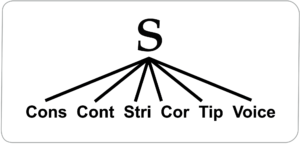
But no phonetic theory postulates anthing like this. Many theories just eliminate the consonantal feature and collaps stridency, coronality and the tongue tip quality into one, giving a three way branching. But here a three way branching is ruled out because it conflicts with the much more advantageous principle of recursive, maximally two way branching, as shown in Nunes (2002).

The branching can recur any number of times. But with any number of binary features, the ordering is the factorial of that number. With six features, there are therefore 720 logically possible orderings.
If underspecification is not just ‘radical’, as suggested by Diana Archangeli in 1984, but maximal, as suggested by the proposal here, if the underlying representation of speech sounds in the lexicon is by the smallest possible set of features to keep words apart, the rules necessary to generate the forms of pronunciation have, of necessity, to be ordered in language specific ways. For the sake of maximality, these may sometimes interacting with syllable structure, as in the case of English S. Here S is only possible segment if there are two following consonants before the vowel. Of necessity again, the ordering here has to be learnt in full and from scratch, with the ordering critically significant. The earlier any given implementation is ordered, the less it is likely to be involved in variation. This is detectable, and may be critical in the natural process of learning. Whatever the number of steps, there are as many orderings as the factorial of that number. If there are, as suggested under the heading of S and Z, eight critical features here, only one underlying, there are seven factorial or 128 possible orderings of the implementation rules with a corresponding variety of phonetic effect.
Putting things very briefly, by the approach here, in a way which has been said many times before, I contend that phonetics is late phonology. But with the sometimes fractious relation between the disiplines, this characterisation may be regarded as itself contentious.
The phonetic alphabet
The term, phonetics, is used to define International Phonetic Alphabet, designed to represent the sounds of any language, either underpinning or contradicting any notion of universality.
See also Features, Phonology, Phonotactics and Syllables