

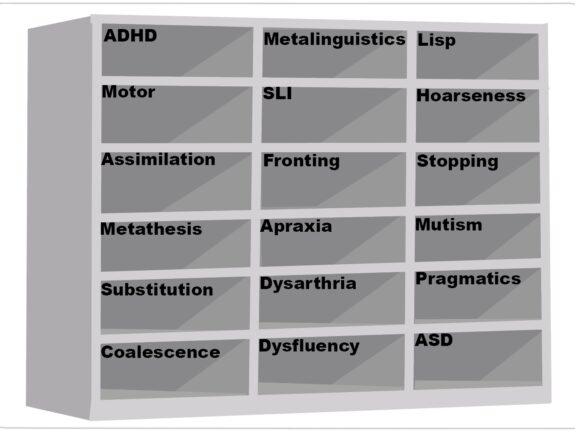
Beyond pigeon holes
Taking account of the individual’s uniqueness
There are categories which are useful, for issues to do with fluency, or hoarseness, or a worry about the pitch of their voice. Such categories point (mostly) in clear directions, not that they are always easy or quick to fix. In many cases, they involve processes of the mind and feelings about the self which need to be thought about over a period of time.
But there are also categories like
- The lexicon, the mind’s store of words and parts of words and whole expressions, which are stored in such a way that they can be retrieved at prodigious speed and with great facility, subject to procedures which vary from language to language and have to be learnt (this normally continues up to the age of seven eight or nine);
- The syntax which determines how words are organised in relation to one another to give particular meanings;
- The system of literacy which has been developed in several different ways over the last four thousand or so years, including the alphabetic system which originated in the Eastern Mediterranean, which some children find very hard to learn (as I did)
Many children have difficulty with more than one of these, suggesting that there is an underlying commonality here.
Every child with any sort of problem with speech and language is an exception to the generalisation that most humans learn to talk naturally without help or instruction over about ten years. In a very loose way there are patterns in this population. Many children find the word, Monopoly, hard to say. They oftensazy the N as an L, resulting in realisations as MOLOPOLY. But they very seldom do the opposite. Monopoly as MONOPONY is usual. But there are exceptions to the exceptions. These are the children who are baffling hard to understand, commonly needing a lot of help over a long time.