

Moral imperatives
Kindness, gratitude, conscience, honesty, sincerity
Language and species survival
Religion teaches kindness, gratitude, conscience, honesty, sincerity. It is hard to see how a dominant mammalian species such as humans could survive any adversity without these moral imperatives and the language to define and discuss them.
But modern human society demands more than this. And by modern human society I mean all living humans, including the handful of surviving hunter gatherers, as well as financial and cultural élites in the capitals of super-powers. Such societies depend on a recognition that there is value in sincerity and honesty, even if many well-known members of them show little sign of either. They know what the words mean.
The evidence of archeology shows that, on the broadest definition of humanity, many groups have died out. It is mostly unclear how and why. But that they died out seems clear. The adversities were real, including rampant infections running through the group, transmitted in some unknown way, or climate change or a sudden change in the course of a river abolishing a whole eco-system. There are significant defences against some such adversities by kindness at least. Defences were life-preserving, and, in the limit, species preserving. But kindness alone may be not enough. Some adversities are just overwhelming.
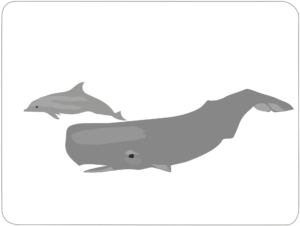
There are many accounts in history, prehistory, and modern observation of kindness by non-humans, either towards humans or towards members of another species. Plainly this goes beyond species survival. My picture here shows a dolphin guiding a much larger cetacean from a narrow, hard-to-navigate inlet, an observed event. On one interpretation of the Old Testament, the story about Jonah and the whale is one instance of this. A cetacean found Jonah at sea, presumably having fallen overboard in the Mediterranean, and decided to help him get back to land. If the cetacean was a dolphin, he or she could have allowed Jonah to hang onto his or her dorsal fin while swimming slowly, on the surface, to the nearest land. A bit more fancifully, Jonah got his name, as a nickname on account of his extraordinary story. One version of that name is still the word for dolphin in much of Turkey and Kurdistan. Another version is my second name. Wild cetaceans of various species have approached humans for help or rescued other cetaceans of different species. Grievously wounded wild elephants have approached humans for help. Dogs have sacrificed their lives to save the lives of their human families. In a less extreme way, I once had a complete manicure for the hangnails on all of my fingers from a macaque in a small zoo. In those days, it was easy to reach through the barrier in either direction. A sperm whale who had saved a marine biologist from a shark sought her out a year later and took her for a long ride on his back. A dolphin who had been freed from an entangling fragment of a discarded fishing net carefully went nose to nose with each of his rescuers. In these encounters, there is clearly an understanding of kindness. Without in any way querying Darwinian biology which I firmly uphold, there are things which it cannot explain.
But in human society, life-and-death rescues are not exceptional events, but part of the way the society operates. Crucially, they are all mediated by language. Neanderthal humans clearly survived broken limb bones or the loss of all their teeth, any of which would not have been survivable without the kindness of other members of the group. By the proposal here, they must have had language, but not modern adult language with the complex embedding of clauses. That is the language of a modern child under the age of three or so. Such a language clearly allows statements which are either true or false. Small children enjoy absurd untruths: “Daddy is eating a dinosaur”, “Mummy is sleeping on the ceiling”, and so on. At least some times, such statements can be funny. As soon as language had evolved to this degree, honesty and sincerity became meaningful qualities in discourse. And the moral imperatives are plainly of a quite different order of the cetacean clearly communicating ‘Thank you” or “Good to see you again”. We can now discuss what moral imperatives are.