

Proposal / Hypothesis
Evolution and acquisition
A specific and unique sensitivity
The evolution and the acquisition of language
Subjects and data
Some steps
-
-
Lexicon
-
Greetings
-
Statements
-
Questions
-
Inflection
-
New meanings
-
Subordinate clauses
-
Binary branching
Precursor cognitions and conclusion
A specific and unique sensitivity
For the overwhelming majority of humans, in the first months of life, a special sensitivity starts to develop, a sensitivity which has no equivalent in any non-human species. The baby starts learning to talk. This sensitivity lasts throughout childhood, but normally not beyond childhood. That much is obvious, beyond dispute. But by the proposal here, from empirical data, the way speech and language work and the way they are learnt by children are a direct reflection of the way they evolved in the human species.
The sensitivity here defines both an infinite capacity and significant commonalities across all members of the human species, irrespective of the language, no matter whether the speakers are numbered in the thousands or in the millions. The Faculty of Language or FL is plainly not expressed at birth, but it develops throughout childhood by ‘acquisition‘. Children are expected to master this FL without any special help or instruction, other than on words which they may hear said, but should not use themselves. The fact that acquisition is possible is known as ‘learnability‘. Of course, linguistic functionality is sometimes impaired. Hence this website. But there is today no such thing as a ‘primitive language.’
There are two big differences between modern acquisition and the historical evolution of the functionality. What the neonate inherits is a copy of the Universal Grammar, UG, as thisn has evolved at some given point in evolution. This becomes the basis of FL. What the baby and small child hears is bits and pieces of the grammar from more competent speakers, much of it in bits and pieces as speakers change their minds or just muddle their words. Even if the child never hears anything but perfectly formed words or sentences, what he or she happens to hear said is essentially random. But the end result is a well-defined UG. The contrast between the randomness of children’s experiences and the generality of the end-state is often referred to as the logical problem of language acquisition.
As David Adger (2019) points out, most of what is said and reliably understood has, almost certainly, never been said before in the whole course of human history. Templates are not enough. The understanding is with respect to an infinite novelty.
Following an analysis originally due to Noam Chomsky (1965) and work by him and many others since then, I assume here that UG and FL are strictly human-specific, by an inheritance, expressed partly by the human genome and partly by human experience. For the sake of learnability, acquisition needs to be broken down into its simplest possible elements, some specifically linguistic, and others defined by general cognition.
The evolution and the acquisition of speech and language
By the proposal here:
- Acquisition Recapitulates Evolution.
- Speech and language evolved by a series of distinctive steps, each one essentially simple, as reflected in children’s acquisition, in the range of a million times faster than evolution.
- Like any other natural process, acquisition can go wrong, due to a biological error, or by some human disruption, such as long term seclusion, as forced by Covid regulations in 2020, criminality, or social deprivation.
The proposal here has an immediate application. The long term effects of Covid seclusion are only now becoming apparent. For how many children and for how long are the effects likely to last? Will those affected just grow out of it? Nobody knows. Such questions bear directly on clinical linguistics. But the proposal here makes the questions urgent and important.
The properties by the proposed sequence here are abstract. But they are no more abstract than the straightness of the line between footfalls which the child is learning to walk along. The straighter the line the more efficient the gait becomes. More energy is used to propel the body forwards, and less to stay upright. This gait allows humans to run for longer on two legs than faster-running prey on four legs. But few, apart from trainers in athletics, think about the straightness of the footfalls. Abstractness is useful in relation to speech and language, as well as for athletics. When the acquisition process goes wrong, some abstractness can usefully guide the process of clinical investigation. What questions should the clinician ask when? This is what the proposal here is about.
Consider the child of three who seems to have just one word. What does this mean? What is the likelihood of the child learning to talk normally? Have the parents done something wrong? Is the child likely to grow into an adult with a ‘communication problem’? Is there a way of reducing the chances of this? What can be done to help? To answer such questions, it is worth sharpening our understanding of FL and UG and, I submit, their likely evolution.
Why ask about evolution? It is obvious that speech and language evolved. But how? The work of Darwin prompted many speculations. By one, language originated originated in expressions like bow wow and woof woof. But in 1866, the Linguistic Society of Paris banned all discussion of the topic. The speculations were not science. And there may have been a suspicion that research would point towards an African origin of human language, undermining the assumption by most Western intellectuals at the time of white European superiority. But whatever the motivations of the ban, it held for over 100 years. The first breach of the ban was by Eric Lenneberg in Biological Foundations of Language (1967) with an appendix by Noam Chomsky. Now the evolution of speech and language is the topic of conferences, journals, books, and touched on in movies and novels.
Robert Berwick and Noam Chomsky (2016) propose one decisive step, discussed below, putting two words together. They characterise this as ‘Merge’. By the proposal here, the notion of Merge needs to be reformulated in order to encompass the first steps, before the notion of words was well-defined when the merging involved not words, but the foundations of words and, separately, the speech sounds with their own internal featural elements, and. in relation to one another, the structure of simple syllables. So by the time the first words evolved, there was already a quite elaborate structure. And there was not one step, but a series of steps, by ideas from Nunes (2022 and 2024). Necessarily each step was essentially simple, and part of the same evolutionary sequence.The way the steps are grouped and organised in relation to one another is the main topic of my current research, mainly by the proposal here.
This succession of discrete steps is quite unlike an informal observation of first language accquisition, which seems to be a continual process of advances so small that they cannot be usefully distinguished from one to the next.
By the proposal here, the acquisition of speech and language by children today and the life long capacity of humans everywhere to go on learning new words, must follow the original evolutionary sequence. It is reasonable to suppose that the evolutionary sequence was over thousands of generations rather than the days and months of modern acquisition.
This stepwise treatment is motivated by the evidence of language acquisition, and by the evidence of UG. My proposal of a sequence of highly discrete steps departs in significant ways from the proposals set out by Chomsky and others (2023). I thus assume that language represents a most useful adaptation, and could not have evolved entirely by means of a single mutation. But my proposal here thus rests on a vast archive of empirical and theoretical work, almost entirely initiated by Chomsky since his first major work, written in 1955.
If acquisition exactly follows evolution, this has a significant bearing on what can usefully be done where the normal acquisition process goes wrong, as biological processes sometimes do. Proposed interventions can be compared in terms of how far they correspond to a plausible evolutionary sequence.
Shigeru Miyagawa and others (2025) propose that the whole process of modern human language evolution must have been fixated across the ancestral population by around 135,000 years ago. By the proposal here, it must have begun much earlier, perhaps around 1.5 million years ago, as suggested separately by Derek Bickerton and Daniel Everett in various books and by Steven Mithen (2023).
Subjects and data
The subjects here represent the smallest sample for any logically possible generalisation, two. The subjects were the youngest two of my three children, Joe and a younger brother, Frank, both developing normally, from a liberally-minded, middle-class family, interested in books, museums, galleries, history, art and politics. They went to a neighbourhood, non-denominational, local authority school, catering for children from a wide variety of social and ethnic backgrounds. The observations are from diaries kept by my wife and myself over ten years, now amounting to about fifteen thousand observations, filling nine cathedral analysis note books.
We tried to make our observations as accurate as possible, as soon as possible after the event. Obviously we must have missed many developmentally significant occasions. The observations exampled here exhibit commonalities across the two boys. It is not plausible that the older of the two was significantly influencing the younger, other than on matters of interest to two small boys. Listening to them talking with their friends and peers there was nothing obviously singular about their speech and language. Generalisations across the two are thus likely to be significant.
Both speech and language are enormously complex. The first efforts are, by virtue of this rather obvious fact, hard to understand – to the point that it is often hard to decide exactly what is being said. But on this basis, any degree of structure understandable as speech may be intrinsically significant.
It is only coming back to these records for analysis forty years after they were made that it is becoming clear how much they reveal. One cannot listen too carefully to the details and nuances of what children say. They can say more than they seem to on a first listening.
Following the convention established by Jean Piaget, ages are given as 0; 11 (10), meaning the tenth day of the eleventh month. For our purposes here, this degree of precision is useful. Some developments happen over a few days, or overnight, or less. In the cases exampled here, the observations were the first cases of utterances satisfying some particular, grammatical criterion.
Some steps
All of the steps proposed here can be stated in terms which make no reference to any sort of linguistic category. Or they could not be encoded in the four-letter alphabet of DNA, capable of being transmitted from one generation to the next.
Some of the steps are as follows.
1. Lexicon
Any system of communication based on discrete meanings and external symbolisations entails a linking between two unlikenesses, a meaning and a physical gesture or externalisation. This is necessarily a two-way relation. Such a relation has to be postulated for the alarm calls of many species, including the naming calls of dolpins, and the much more elaborate communication systems of chimpanzees. But for human language, this relation has to be defined in a new way, allowing it to develop into the raw material for poetry, songs, jokes, irony, words and sentences of indefinite length, legal contracts, political treaties.
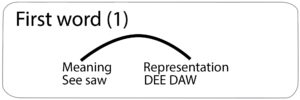
Consider Joe’s first word at 1; 0 (14), seeing the swings in the playground said something which his mother understood as “See saw” – as DEE DAW. The consonants here are what are known as ‘voiced stops’. They are stops because the mouth is completely closed to the airstream. In this case the closure is by the tongue tip. The closure is said to be ‘voiced’ because the action is only momentary, with the buzzing sound from the larynx beginning as soon as the closure is released. The partial closure by S is replaced by complete closure.
On what might seem to be the simplest possible analysis, DEE DAW is by a simple chaining of elements, an unanalysed consonant and vowel, parrot-like mimicries of speech, different, from a non-human expression only by the fact it identifies something in the real world.
Such an analysis might seem be motivated on the basis that it is parsimonious to delay for as long as possible the point at which we postulate any sort of grammatical capacity, perhaps until the grammar is generating structures with a degree of complexity, such that the infinite capacity by FL is obvious.
But this would be to postulate two pathways, one leading to a finite set of outputs and the other leading to an infinite set. On the grounds of continuity, the greater parsimony is by a single pathway, a continuity with the rest of the pathway to competent speech and language, respecting the complexity of the child’s first word, whether this is understood as referential, calling up an entity not actually present at the point of the utterance, as by mum, mummy, dad, daddy, cat, pussy, dog, doggy, horse, horsey, bird, birdie, car, bus, lorry, or as a standalone expression of discourse like hello, hi, or goodbye.
In evolutionary terms, the human innovation was to increase the branching between the unlikenesses.
In the modern child’s first words, the externalisation may involve the reduced resonance of the initial consonant, and the highly-filtered resonance of the vowel, defining the phonetics of the expression, as sketched below. The first step in this process was and is to reduce the external elements of the expression to their simplest, logically possible, perceptibly distinct forms, contrasting sorts of featural element, and then to reverse the decomposition, recombining elements for the sake of clear articulation. This is diagrammed below in terms of two features, relating to the vocal tract and the tongue. By the proposal here, all human expressions rests on this foundation of branched representations.
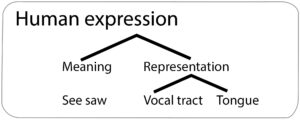
What makes this different from a chimpanzee’s hoot or shriek or warble is the double branching. The recomposition gives their assembly into some prototypical part of a phoneme or speech sound. But primordially and in modern children’s early speech and language development, the recomposition may be uncertain or not fully defined. So there is no reason to expect that primordial expressions sounded like modern EE, AH, TOO, COO, DEE or DAW by modern phonemic or syllabic structure. Modern chimpanzees’ apparent inability to copy human speech tells its own story. Primordial articulations may have been different in any number of ways, in all probability using features that could be drawn from an existing system of shrieks, hoots, grunts, or howls. But by virtue of the double branching, the first human language was on a new pathway.
In evolution, the physical aspect may have been either gestural or vocal. Mike Tomasello (2020) and others argues for a gestural origin. But if primordially there was a bias towards physical gesture, this bias must have disappeared as language evolution progressed, or there would be sign languages used natively by normally-hearing populations, without the encouragement of a significant proportion of the population born deaf. The fact that no such populations have been found is an argument for the assumption here that the first human language was vocal.
By the proposal here, the initial prototype word is likely to have not differed very much from an ape-like hoots as a result of the new process. But there must have been a perceptible difference in order for the evolutionary novelty to spread. It is reasonable to suppose that the fitness advantage of this more complex arrangement was that it enabled speakers to effect their gestures more accurately, to focus on their effect, and to classify them in a prototype dictionary, a lexicon of comparable items, differentiating features more narrowly and more precisely.
By the proposal here, Decompose and compose should be seen as the basis of the process by which linguistic atoms are put together to form the basis of the lexicon. It is both primordial and the first step on the modern acquisition pathway.
The first word was not just referential and different in that way from a chimpanzee’s gesture. It involved different levels of branching. Even with only a small number of the features that characterise modern, fully competent speech, the features can be cross-multiplied, and the lexicon can be expanded.
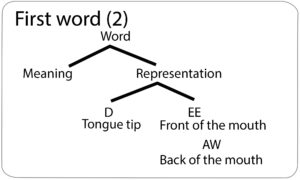
On a completely different time scale from modern acquisition, the lexicon could grow exponentially. One form could be compared with another. New forms could be added, each distinctively represented by branched structures, to be articulated and understood accordingly.
Both by evolution and by the fully evolved modern system, such a ‘lexicon’, or store of words or signs, could be freely supplemented throughout life. Lexical items are thus quite different from any shriek or howl in response to some situation.
The relation between physical and semantic features and the classification of entries in a lexicon are common to all naturally spoken, modern languages. This breakpoint between human and chimpanzee-style communication cannot have been by a gradual transition, but by a reconfiguration of the relation between meaning and gesture. This reconfiguration was the evolutionary cognitive genius. Without the decomposition and recomposition, there is no way that the primordial hoots and shrieks could have evolved into what they became.
By the combination of different underspecification theories proposed here, words are stored in such a way that they can be quickly found. Words as stored in the lexicon are highly compacted. Although the principles of this are common to all languages, the detailed implementation is language-specific, necessarily within the child’s learnability space. Nunes (2002) shows that this learning is still normally still in progress at the age of eight, at least for the hardest words.
The principle of compacting is plainly not learnt. It has to be available to the child from day one. It has to have evolved to be able to work the way it does. This evolution cannot be an aspect of human culture or it would vary from culture to culture. By the current notion of ‘Biolinguistics‘ it has to be biological.
Lexicon defines the beginning of a human-specific pathway
How far the first inventor or inventors were CONSCIOUSLY aware of what they had ‘invented’ is obviously impossible to say. But it seems reasonable to speculate that even just one suitable expression could be very appealing, that there was a selective advantage. More mental investment in the form may have allowed more attention to other aspects of the expression. The adaptation here wouold seem likely to have conferred a degree of advantageous fitness. Inheritors had a greater chance of mating and thus of passing the adaptation on. All we know is that it was noticed. Or it could not have spread.
Even if the first word or syllable is imprecisely articulated and hard to even identify, it still has some rudimentary structure, typically with an initial consonant followed by some sort of vowel. There may be a second syllable, as in Joe’s “Dee daw”.
By the framework here, it is likely that both primordially and in modern acquisition, definitions were and are imprecise, making the speech is hard to understand. The structure (or lack of it) is both primordial and characteristic of early development.
Modern language exploits the complete resources of a system which is continually changing in how things are pronounced, in how words are put together, in what they mean, and so on. But, that being said, it is now, in a sense, fully evolved. The primordial system has been supplanted by both evolution and what is known as ‘grammaticalisation’, the churning over of the grammatical apparatus under various pressures over tens of thousands of years.
There are fossils of the primordial sound / meaning relation, as expressed by the modern lexicon, in:
- The lexicon itself;
- The sending of information of two sorts to two quite different sorts of interface, both conceptually necessary, represented in primordial human expression, and as significant in modern speech and language as at the point of evolution;
- The long period in normal language acquisition, of anything between two and six months, of just single words;
- English yes and no and what are known as ‘modal particles’ or ‘discourse markers’ including Ah for pleased surprise, Eh as a query, tut tut for disapproval, hello, bye bye, curses, and so on;
- What are known as ‘imperatives’, commonly, as in English by the ‘root’ form of a word, such as come and go, sometimes for the sake of saving life;
- Expressions like “genius” or “rubbish” in response to a performance.
The single words of modern one year olds are unlike the primordial forms proposed here in that they exploit combinations of features by later steps. But they are used in a way characteristic of the primordial system.
2. Greetings
Greetings signal a personal relation between people in a particular sort of situation according to their familiarity. For small children, they signal a momentary relation.
By the first greetings, there is a reduction of the number of elements involved by pairing the simplest sort of element such as bye-bye, with a reference to some animate entity. The contrast is between elements such that one relates only to the discourse itself and the other is a prototype of what will become an element of grammar. Significantly there are only a handful of discourse expressions in contrast to those entering the system of meaningful, grammatical combinations.
Joe at 1; 5; (23), almost six months after his first ‘words’, said “Bye, doggy”.
Frank at 1; 2 (22) said “Bye bye, Daddy”.
Bye or bye bye are clearly aspects of discourse, as are ah, ey, uh, oh in adult language. Doggy, addressed to a toy dog, and Daddy, are seemingly referential. So there is discourse and reference, but with no internal structure other than the contrast.

This primordial system is reflected in modern language in at least two ways:
- Expressions standardly by root forms combined in ways falling outside the terms of the grammar, kill joy, go between, go slow and so on, noted by Ljiljana Progovac (2015);
- Possibly at least some adverbs, as the only sort of word which can appear in different positions in English, albeit with some subtle changes in meaning, as with sadly in any of all logically possible positions in “Sadly, he is going to die”, “He sadly is going to die”, “He is sadly going to die”, “He is going sadly to die”, “He is going to sadly die”, “He is going to die sadly” – all grammatical, at least for those who allow ‘infinitives’, with to and a verb, to be split;
The modern infant generally puts his or her first two ‘words’ together around the point when the vocabulary reaches around fifty items. There is no reason for assuming that Greeting evolved at the point when some particular number of items became accessible, but it is clearly possible that in evolution Greeting was triggered by the growth of the lexicon.
3. Statements
Many of the first statements are just observations about the world, as it appears to the child, rather than expressions of need or desire.
Irrespective of their purpose, in these first statements, there is a further restriction of the number of elements in the computation by limiting them to different types, as some sort of prototypical categories, with one becoming the head of a combined expression.
For example, Frank at 1; 3 (2) said “Open door”, and Joe at 1;7 (30) said “In er car…. In car”. By the analysis of Chomsky (1995), this is by the ‘merging’ of two “formatives’, in these cases with open or in becoming the head of the merged expression.

In these examples, only one element is referential. The other is a prototype of some sort of syntactic object, in these two cases a verb and a preposition, although not yet with such a categorisation well-defined. Crucially, neither is such that it can stand on its own. Discourse elements are thus excluded. A headed structure can’t include bye bye or hello.
When the phrases “In car” and “Open door” were uttered it seemed probable what they meant, but not certain. The relation is asymmetric between two contrasting elements. But however they should be understood, both of these phrases have well defined heads, in and open, contrasting with the clearly referential elements in car and door. In the framework here, the non-head is known as the ‘complement’. By the diagram above, dominance is thus built into the system.
The head of a structure can merge with another structure, allowing subjects to be formed in the same way.
By a very general relation across the grammars of human languages, not just English, phrases have heads, and heads have ‘complements’ and ‘specifiers’, as diagrammed below. What traditional grammar calls ‘subjects’ are prototypical specifiers.

At 1; 3 (2) Frank says something lile “ER want that”, with a non-specific vowel sound, shown as ER, rather than a clear I. But it is in the appropriate position in the structure to be understood as I. At 1; 8 (22) Joe says “All gone” with all as the specifier.

- With the branching applying to just two elements, headship is thus essentially a relation between prototype syntactic elements, both with parts. In the modern child’s process of acquisition, by the simplest interpretation, “In car” involves two elements, car, essentially noun-like, and in, as a step towards a preposition. “Open door” contrasts noun-like door and verb like open. Thus the abstract (Er) element, noticed in the speech of many children expresses a purely grammatical or syntactic subject role, a seemingly universal property of sentences.
- What are known as ‘thematic roles’, including agency, ownership, location, benefit, destination, or experience, can now be expressed.
- External Merge signals the first step towards distinctive ‘parts of speech’ as these are called by traditional grammar, nouns like car, Mummy, Daddy, verbs like want and like, prepositions like in. The items become differentiated, as the only sorts of expression on which grammatical operations can be defined. On the simplest plausible readings, open and in are plainly heads. Both elements can now express formal relations, as head and complement, to the expression as a whole. There is a grammatical relation between them, each with an an irreducibly necessary, structural role. But it seems premature to regard such elements as fully-defined nouns, verbs and propositions;
- The elements have features which define the interaction, as opposed to some purely accidental relation, as by ooh, eh, ah, yes, hello, good bye,and so on, all independent from the grammar because they can stand on their own, sometimes adjoined to it, but not by External merge;
- By virtue of the headship role of one element by each branching, and developing an idea from Nunes (2002), it is possible to combine different sorts of ‘underspecification‘, reducing the lexical storage to the minimum, expanding it only for purpose of clear pronunciation.
4. Questions
There are many ways of signalling curiosity, by a tone of voice or a raised eyebrow. The most explicit way is by syntax, defining what sort of information the questioner wants to know. But the syntax has to be formed. Of course, the wanting-to-know can then be turned on its head, in irony or for some other reason.
In modern acquisition, soon after two words are put together, a question is asked or answered involving a question word relating to one of the items in the two word combination, particularly what, where, and so on, signalling points of curiosity, as a key factor in discourse.
English syntax forms a question by reversing the order of the subject of a sentence and the signal of time, known as ‘tense’. This involves a tense-carrying element of the verb phrase, using a form of do if tense is embedded in the verb itself, as in the simplest case. By the profound insight of Chomsky (1957), the marking of tense is separate from the verb itself. Hence “Did you say that?” and the answer “I did”. The force of the question in “Where are you going?” determines a reversal of the sequence of you and are from the sequence which would be followed in the response statement “You are going to the shops” or I and am in “I am going to the shops”. Questions beginning with words like where (or their equivalents in most languages other than English) are asked with where mostly on the left of the structure, as in “Where are you going?” In a full-sentence answer, the requested information is on the right, as in “I’m going to the shops.” Words like where appear to move leftwards. Building on the functionalities by the three previous steps, by a further restriction on the set of elements at play at any given point in the derivation, by an analysis originally proposed by Chomsky (2004), the merging is now from an array of previously selected lexical entries. From this array, it is then possible to extract a particular, suitable item. An item is ‘internally merged’. This further reduces the set of elements in play at any given point in the derivation, and marks what John Langshaw Austin (1962) called the ‘‘illocutionary force‘ of a structure, as a statement, question, entreaty, and so on, in a way separate from its propositional content. In “What did you say?” the word, what, and the whole sentence are different sorts of syntactic object, with what having a special status in relation to the illocutionary act. The ‘force’ of a question is an effect of the structure and the circumstances in which it is uttered.
Typically, as in English, an internally merged item, B in the diagram below, is then not pronounced at its point of origin, shown in grey below.

For example, at 1; 4 (27) Frank is asked, “Who wants some chips?” And he replies “Me”. And at 1; 5 (9) he asks “Where chicken?” Both the appropriate answer to a who question and the where question 12 days later suggest a grammar capable of making two uses of the same element, once to define an identity or location, and then, by Internal Merge, with the force of a question.

Joe at 1;10 (3), says “Daddy upstairs” where Daddy seems to be the subject, and at 1; 10 (27) “Where Daddy?” with where seeming to define a clear question. In the statement “Daddy upstairs”, each element is extracted once from the lexicon. But in the question “Where Daddy” it is extracted with a notion of location, and then extracted once again with the force of a question. In other words, where is pronounced on the left of the structure, and interpreted on the right , where it is left unpronounced.

At this point in the development of the child’s grammar there is no evidence of any category corresponding to ‘Tense’, as by the difference between do and did. All we have evidence for is an interpretation of an element pronounced in a different position from where it originated, as shown by the green arrows.
By this step:
- Elements of composed structure can be recomposed at a higher level;
- The cognitive load of searching for and extracting items from the lexicon is greatly reduced. At this point in language acquisition, the lexicon is expanding rapidly. Simplifying the task of searching for and extracting a word is thus a valuable increase in fitness. This is easily and obviously detectable because questions are now defined by the ordering of elements, although not yet by any overt expression of Tense. Questions with a Wh word can be asked or understood.
Significantly, English also allows forms like “Daddy is where” or “The chicken is where”, typically with where heavily stressed, no longer with the force of a question, but as statements of surprise or astonishment.
5. Inflection
Questions are not fully-defined, at least in English, by the leftmost positioning of a Wh element. For clearer understanding, there needs to be some evidence of the pivotal ‘Inflection’. The simplest case involves a relation to the immediate present, defined not on the verb itself, but on a higher position on the ‘spine’ – what was traditionally and in earlier versions of the framework here, characterised as the ‘auxiliary’. In relation to existence or situation, the inflected form of Be is expressed by the word is or its contracted form, written as ‘s.
While Question extracts elements from a work space, Inflection projects them upwards – necessarily because that is the only possible direction.
Projected elements, known as ‘functors’, are only definable by their relation to another element within the structure or to the structure itself. Functors are marked in English in obvious ways, easily detected by the child learner, such as optionally losing the vowel, as in this csse.
Frank at 1; 5 (29) asks: “What is that?” His mother, who made the observation, noted that the is form was clearly articulated. Joe at 1;11 (12) asks “Who’s that?” On the same day, looking at a picture book together, his mother asks: “Where’s the bus?” Joe replies: “There’s bus.” At 1;11 (14) he asks: “Where’s man tractor?”. It was not clear whether he meant “Where is the man’s tractor?” or “Where is the man for the tractor?” or something else. The point here is the articulation of the ‘s form, as a contracted form of is. These are the first uses of an is or contracted ‘s form by these children. Here an element is inserted into the structure and anchored to the here and now of the utterance, reflecting an aspect of the discourse. The functor here does double duty, marking both the relation to the present and the fact that the question is about a single entity. The fact that it can be expressed by a contraction makes it highly visible and thus easy to identify and learn.
Showing the new functional projection in quotes, it is projected to a point in the structure where it is the sister of the question form, here what, who, where.

There is no reason for thinking that there is any contrastive intent here. The child is not also asking things like “What was that?” The ‘S or is just defines an abstract projection, albeit one with a significant role. In a broader sense, the form signals the accessibility of elements which are purely functional, with their own corresponding projections.
6. New meanings
The sixth step restricts the syntactic action to just two, closely-related elements within the structure. There are just two elements to be considered here, This barely makes sense as an evolutionary / developmental step, other than in the more general context of reducing the workload by each step. The relation characterises numerous phenomena in the grammar – in English a seemingly disparate set of functionalities. Five of these functionalities emerge in the same order in both of the subjects here.
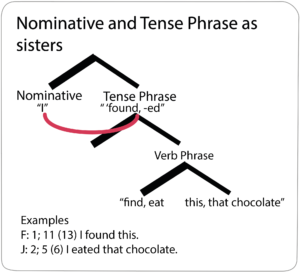
- A ‘sisterhood’ relation between the Inflection and what is known as ‘Case’, expressed by the difference between I and me, essentially who is doing what to who, but changing as roles change or speakers take turns to talk, with agreement between the subject in the ‘nominative’ case and the form of a verbal element expressing tense, as between I and am, or its contracted form ‘m;
- Successions of verbs as by want to go, where want ranks above go in the structure. Verbs like want are known as ‘control verbs’ because they control the tense, person and number, i.e. all the variable features of the lower ranked verb;
- What are known as ‘passive’ forms such as broken, where what is known as the ‘theme’ or ‘patient’ of an action comes to dominate not just the verb, but also in English an auxiliary form, such as is;
- Negatives by not and its reduced form written as ‘nt, where the negative form only appears immediately after the form expressing the tense in doesn’t, didn’t, can’t, won’t, and so on.
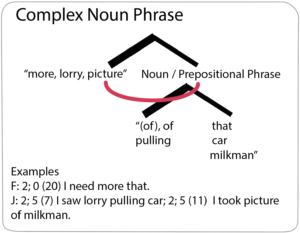
- Complexity in ‘noun phrases’ defining possession and qualification, as in Morph’s box and that thing boiling in “What that thing boiling”;
The common ordering, the fact that in some cases, more than one of these phenomena are manifested in the same utterance, and the fact that they emerge in one short period is consistent with the claim here that they are by a single step. Another functionality, what are known as ‘reflexives’, as in “I hurt myself”, seemingly by the same underlying mechanism also emerges at the same time, though in different orders in the two children:
At this point in their development, in terms of their chronological age, Frank, the younger of the two, was some months ahead of Joe.
Case
For both children, there is the same sisterhood relationship between I as the subject with overt nominative case and the overtly inflected past tense of the verb. Frank at i; 10 (27) said “I found this”. Joe at 2; 5 (6) said “I eated that chocolate”, the next day at 2; 5 (7) said “I saw lorry pulling car” and on 2; 5 (11) “I took picture of milkman”. In Joe’s at 2; 5 (6), the tense in the verb is manifest in the mistake in eated.
Control
At 1; 11 (1) Frank said “Want sit lap” with two root forms of the verbs, want and sit. At 2; 3 (26), Joe said “Want help daddy” where it seemed that he wanted to help his father. In Frank’s case want and sit, in Joe’s case, want and help were separate verbs, one at a higher position in the structure than the other. Want is known as a ‘control verb’ in as much as it controls the tense, number, and person of the lower ranked verb, in these cases help and sit.

Passive
At 1; 11 (3) Frank says “Baby is hit”, and at 2; 4 (11) Joe says: “Morph’s box is broken”. In both cases the patient or theme, baby in the one case, Morph’s box on the other, dominates two verbal elements, is and hit or broken, one dominating the other, rather than being dominated by s single verbal element.

Negative
At 1; 11 (4) Frank said “I don’t like it” with the negative n’t next to the auxiliary do. At 2; 4 (26) Joe said “Mog doesn’t like that”.

Complex noun phrase
At at 2; 0 (20) Frank said “more (of) that“ . At 2; 5 (7) Joe said “Lorry pulling car” and at 2; 5 (11) “I took picture of milkman”.
Reflexive
At 1; 9 (22) Frank said “I hurt self’”, meaning I hurt myself, with I and self with the same reference, with the reflexive self-form one level down from what is known as its ‘antecedent’ – in this case I. And at 1; 10 (27) he said “I found this” with the ‘nominative pronoun’ I next to the past tense found. At 2; 5 (5) Joe said “doggy licking hisself” with the self form picking up the third person of the antecedent.

A single relation
There is the same sisterhood relationship between I and am and between she and is, one denoting the nominative case of the subject and the other denoting the most immediate aspect of the here and now in the discourse. In most languages including English, the key aspect of the here and how is related to time, represented as the tense of the verb, as in the differences between I am and I was and I have and I had. Nominative case is almost enirely grammatical, with no general relation to the needs of communication or the factuality of the here and now. This is disguised by the fact that the subjects of sentences often encode the thematic role of agency, as in “I’m making a lorry”.
The expression of these levels of the hierarchy, for noun and verb like elements, varies from language to language. These are things the language learner has to learn. They fall within the learnability space. But the way it works in English is complex and hard to learn. Applied to the output of one another, the set of relations defined so far can be exploited indefinitely. Such a grammar strains both processing and production. It may not be completely learned under the condition of finite learnability. There may have been wide variations in the mastery of the grammar, as in all other areas of human skill from musicality to art.
7. Subordinate clauses
By this final step, an element, to be known as ‘Complementiser’, is introduced with the effect of completing the derivation, merging with the current structure by the general principle that this applies to just these two elements, itself and the current structure. As the topmost element of the structure, the complementiser defines the force of the structure as a whole. In this way, the grammatical apparatus is factored into narrowly-defined phases, further reducing what is at play at any point in the derivation, but allowing sentences to be of any complexity.
This follows a consistent approach from Chomsky’s first widely circulated (1957) work, proposing a distinction between two sorts of rule, ‘phrase structure rules’ introducing the ‘content’ elements in propositional form, and ‘transformations’ manipulating those elements for the purposes of what John Langhaw Austin (1962) would call ‘illocutionary force’, including questioning and denial. In 1965 Chomsky proposed a division between deep structure and surface structure, with the transformations happening between them, and the rules applying in cycles. In 1986 he proposed the notion of ‘barriers’ with respect to what was at the time considered to be the ‘movement’ of elements such as what and where. Then in 2001 he proposed that information is ‘spelt out’ to two minimally necessary interfaces, defining the meaning and the external pronunciation, in separate ‘Phases’. This is still an idea in the process of intense development and debate, with many different understandings.
By the understanding here, from the perspective of acquisition, but taking also taking account of evolutionary plausibility, each phase has two main aspects, the first comprising the referential and propositional content of a structure, defining the extent to which something is true, false or implicit, the second defining the illocutionary force of statements, commands, questions, pleas, and so on, possibly contradicting the proposition in jest or irony. Discourse features significantly in this second aspect.
A phase is defined by the fact that as soon as it has been completed, most of its structure becomes inaccessible to the ongoing process of derivation. A phase may by expressed by only one word. But it gets a special analytic status by hosting the Wh words.
The novelty, by a phased approach to syntax, is that the factoring into phases can be repeated. The phases are accessible to small children and plausible at an evolutionary level. Both in the evolution of language and in the acquisition of language by modern children, the factoring of the grammar by phases is (necessarily) ordered last.
Here I show accessible elements in bold red, and with a lower, earlier, inaccessible elements lighter.

By this seventh step, the notion of force is expressed as ‘Complementiser’ or C, as the topmost level of the spine, and replacing the traditional notion of a ‘sentence’. Complementisers comprise a small set of words, including words like for in “For Daddy to put on your shoes would be a bit difficult” or that in “That your feet have grown is obvious”. Not part of child language in these cases but necessarily on the pathway to full competence. In simple main clauses, C is not expressed in English. But it is the destination or landing site of words like what, where and when and expressions with which in questions seeking particular items of information. So C provides a hosting for what in expressions like “What did you say you thought I said?” with what as the complement of I said at the opposite end of the structure. By the 1997 proposal of Luigi Rizzi, the ‘force’ of the structure is expressed as a property of C. This applies no matter whether the structure is a statement or a question, or whether the agency of the subject is diminished by passivisation or in some other way.
The critical evidence for this seventh and final step seems to be those cases where a word like what is used as part of a statement – or ‘declarative’ – but without the force of a true question. These are minimally structures with two clauses, typically the first with a ‘mental’ verb like think, know, wonder, remember. The child becomes able to process a structure with a word like what on the left edge of an embedded clause with an auxiliary form with tense overtly marked immediately after it, as a statement about knowing or wondering. I illustrate this with the first two clause instances from Joe and Frank, with the topmost part of the structure with a simple red and black triangle. The seventh step is in the act of embedding one clause inside another.

By characterising the topmost level as C, shown here in red. every level from the bottom of the structure to the top is defined in the same way, rather than by giving the sentence a special status of its own.
A mere six weeks after “I don’t know what you want, teddy” with a single embedding, at 2; 9 (28) Joe produces his first sentence with multiple embeddings in “I want to stand on the chair to see what’s happening”.
The other child, Frank, up until this point, the more precocious of the two, now, at 2; 10 (21), says “I want to sit where Joe’s been sitting.”
Crucially, there is no search for information here. Simplifying slightly:
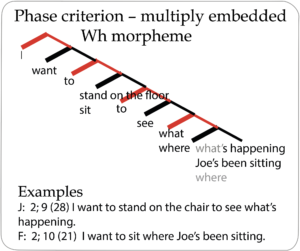
Looking at the two children together, almost identical, sentences with multiple embeddings, accidentally or otherwise, with full grammaticality. The exactness of the similarity between two utterances in two children two and half years apart would seem to suggest that there is significance in such structures with a Wh word specifying an embedded clause, and not forming a question.
For both children, one aspect of this step is the emergence of questions with when, how, and why, with correspondingly more complex structures on the right edge. But the fact that the commonality across the two is stronger and clearer with respect to the two clause, non-question forms, suggests that the driving here is from the phase structure rather than the obviously important differences between when, how, and why questions with clear question force in a single clause.
As by the examples above, Phase allows the derivation to proceed in steps, as by the process of evolution. But the full application of the principle here takes years to learn. At 9; 9 (13) Joe said “We don’t know whether I’m going to be picked up by who” (of the rather complicated child care arrangements we had in place at the time to allow me to go to a university 70 miles away one day a week). Joe’s sentence is anomalous in as much as who seeks particular information and whether seeks only a truth value. But the structure of two Wh words in the same clause calls up the Phase functionality in a significant way.
By this seventh step:
- Building the derivation in phases allows clause structure to develop, while at the same time limiting how much of the derivation can be manipulated at any one point, reducing to the minimum both Search and the speaker’s and language learner’s tasks in constructing a derivation, allowing complexity to be distributed across it;
- No matter whether Wh words like where and what are used in questions like “What do you want?” or as introducing an embedded clause in a statement like “I know what you want”, they are crucial to the system of Phase, the last step in the evolution and development of Universal Grammar.
- Information is sent bit by bit to the articulatory system to be pronounced and to the semantic / conceptual system for the meaning to be analysed. English marks the point of sending articulatory information much earlier than ‘agglutinative’ languages like Turkish, with what seem to the speaker of a language like English to be hugely-complex ‘words‘. So this point necessarily falls within the learnability space;
- Hypothetically it is Phase which makes speech and language finitely learnable, at least for the overwhelming majority, giving humans a unique capacity among all species alive on the planet;
- A commonly shared competence can be assumed across the whole population – a huge advantage for a small and highly vulnerable species, as humans were until this point in human evolution. At least two bottlenecks in ancestral populations have been identified from the DNA evidence, with humans almost going extinct;
- Metalinguistic awareness is brought into being;
- Fantasy, fiction, non-fiction, irony, fun, comedy, contracts, all become parts of everyday life.
By the estimate of Shigeru Miyagawa and others (2025), modern levels of competence seem to have become fixated across the population by around 135,000 years ago. The enhanced cooperation by Phase may thus have saved modern humans from extinction. The first step, allowing a prototype lexicon to start developing, must have been correspondingly much earlier.
Binary branching
On the widely shared assumption here, the principle of binary branching is universal across all human languages. But the way it works is language-specific and thus falls within the learnability space, and is often problematic in children’s speech development.
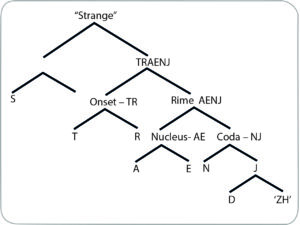
The tree can just develop, adding branches, up to some limit, as by the structure in strange. Here the long vowel is shown as AE, where the two elements are separated in the spelling. The final GE by the spelling is shown as a single J, representing the fact that this is just one sound. But it is also a sound with two halves, known as an ‘affricate’, beginning with a complete closure, shown here with a D, and ending with a fractional release of the closure, shown here as ZH, like the sound at the end of beige and rouge. Respecting the binary branching, the initial S is shown as a dependent off the left edge of the syllable.
Precursor cognitions and conclusion
Chomsky suggests, a single, out-of-the-blue mutation of quite extraordinary power, defined by ‘a minor rearrangement of neurones’, as the singular cognitive achievement of modern homo sapiens.
My proposal here extends Chomsky’s by an evolution over a much longer time scale with steps before and after Chomsky’s Merge. This just seems to me a biologically well-motivated way of reconciling the evidence of human speech and language, as they currently are, with biology, neurology, archeology, paleo-anthropology, genetics, delays, disorders, and the random cases of two individual children.
The fact that the two children whose language acquisition is referenced here were brothers, living in the same family home, may have influenced the areas of their attention and interest. But it cannot have had any bearing on the growth of their separate understandings of Universal Grammar, two and a half years apart.
The proposal here is a sketch. It has been presented in slightly different versions to two international conferences, in 2022 and 2024.